
Named as Edge AI and Vision
2026 Product of the Year


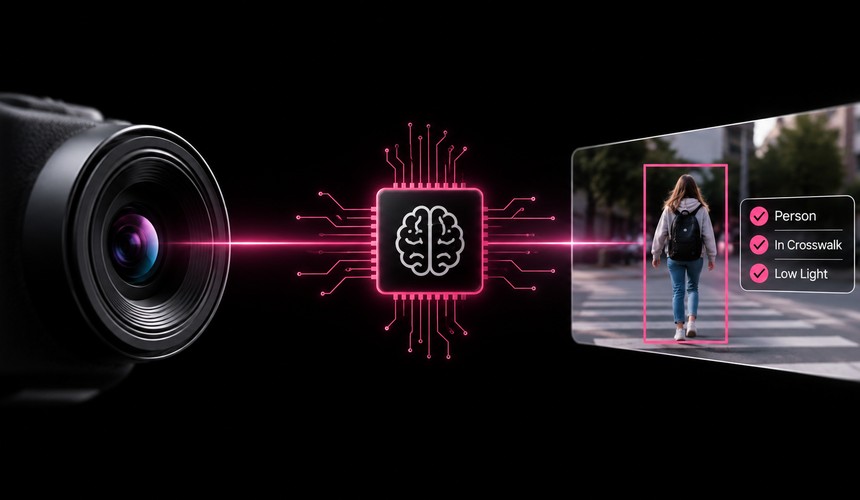
By Oren Debbi
For decades, the camera industry has competed on familiar ground: better sensors, better optics, higher resolution, wider dynamic range and more sophisticated image processing.
That formula has delivered remarkable progress. But the industry is approaching a turning point, and many camera roadmaps have not yet caught up.
We are still designing cameras around the image a person wants to see, while increasingly asking those same cameras to provide the information a machine needs to understand.
Those are not always the same thing.
A picture can look excellent to a human and still be a poor input for a computer vision system. Details can disappear in shadows. Bright highlights can obscure important objects. Noise and motion blur can make visual information harder to interpret. And once information is lost or distorted early in the imaging pipeline, downstream AI cannot always recover it.
This is why I believe the next major evolution in camera technology will not come from the sensor alone. It will come from rethinking the software that turns light into usable visual information.
The camera is becoming software. And the industry needs to start designing accordingly.
The traditional camera architecture was built around a sensible goal: capture a scene and turn it into an image that looks good to a human.
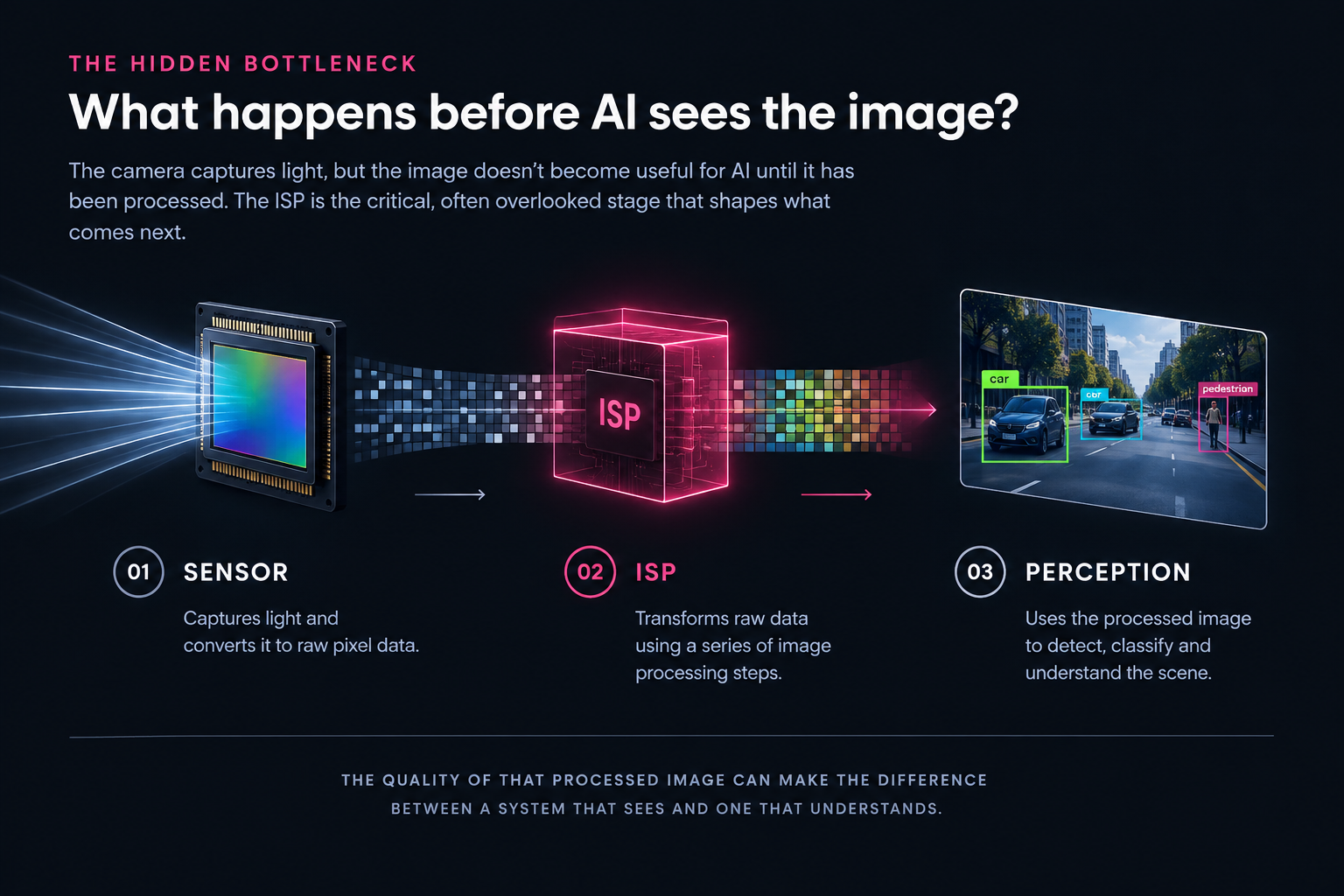
Light reaches the sensor, which produces raw pixel data. An image signal processor, or ISP, then performs a series of operations such as demosaicing, noise reduction, white balance, color correction, sharpening and HDR processing. The result is an image ready to display, record or transmit.
This architecture has served the industry well. Dedicated hardware has enabled efficient, high-quality imaging at scale, within tight power and cost constraints.
But the assumptions behind it are changing.
Cameras are now fundamental components of systems that must interpret the world: vehicles, robots, industrial inspection systems, security platforms and autonomous machines. In these applications, the image is often not the final product. It is an input to another system that must make a decision.
That changes the question we should be asking.
Instead of asking only, “Does this image look good?”, we should also ask, “Does this image preserve the information the next system needs?”
That is a different design objective. And it deserves a different approach to image processing.
The distinction matters most when conditions are difficult.
Consider an automotive reverse camera. In bright daylight, producing a clear image may be relatively straightforward. But add deep shadows, poor lighting, glare, reflections, movement or a sudden change in exposure, and the challenge becomes much harder.
The driver needs to see an obstacle. A computer vision system may also need to identify it, locate it and distinguish it from other objects. If important detail is obscured by noise, blur or poor dynamic-range handling, the downstream system has less useful information to work with.
This is not just a theoretical concern. Research has repeatedly examined the relationship between camera conditions and machine vision performance.
A study published at CVPR, for example, explored neural auto-exposure designed jointly with an object detector. Its approach improved mean average precision by more than six points compared with conventional auto-exposure methods in the evaluated setup. Other automotive imaging research has examined how low light, sensor noise and exposure decisions affect object detection. The broader lesson is clear: image capture and processing cannot always be optimized independently of the task that follows.
Research into automotive camera exposure has highlighted that conventional image-quality metrics do not always correlate well with computer vision performance, reinforcing the need to evaluate images in the context of the task they must support.
This does not mean image processing is the only factor in perception performance. Sensors, optics, exposure, model architecture, training data and the operating environment all matter. Nor does it mean every image should be optimized for one particular AI model.
It means we should stop treating image processing as an isolated step whose job ends when the image looks right.
If a camera feeds a machine, the quality of that camera should be judged partly by what the machine can do with its output.
Much of the attention in AI has gone to the systems that interpret images: increasingly capable models, more compute and new approaches to perception.
That attention is justified. But it can leave a crucial part of the system underexamined: the transformation that happens between the sensor and the AI model.
The sensor captures light. The ISP transforms the raw data. The perception system then works with the processed output.
Each stage affects what information is available to the next.
Traditionally, image processing has relied heavily on predefined functions and carefully tuned pipelines. These methods are efficient and mature, but they were not originally designed around the idea that a learned system could rethink image processing as a whole.
This is where the next architectural shift begins.
If AI can interpret images, we should also ask whether AI can help produce better images for interpretation.
That is not a call to replace every proven component with a neural network. Engineering is not a contest to put AI everywhere. Power consumption, latency, reliability, cost, integration and predictable behavior remain essential, especially in automotive and other demanding applications.
The opportunity is more specific: use learned image processing where it can preserve or recover useful visual information more effectively, and make that processing practical within the constraints of the device.
In other words, bring intelligence closer to the moment the image is created.
A neural approach to image processing changes more than the algorithms involved. It creates the possibility of rethinking how the imaging pipeline is designed, tuned and improved.
Instead of treating every processing stage as a separate, fixed-function problem, a neural system can learn complex transformations from data. Depending on the implementation and application, that may offer a more integrated way to handle challenges such as noise, low light, color and dynamic range.
Running this processing on edge hardware is particularly important. Cameras often operate under strict limits on power, memory, latency, bandwidth and cost. Sending every frame to the cloud is not a practical answer for many real-time systems. Processing must happen where the camera operates, within the device’s available compute budget.
This makes software-defined imaging a meaningful architectural opportunity, not simply a new feature.
It could give manufacturers more flexibility in how they tune image processing for a particular sensor, environment or use case. It could enable improvements through software rather than requiring a complete hardware redesign. And it could allow imaging performance to become a more active part of a product’s differentiation.
None of this makes the sensor or optics less important. The information captured by the sensor still sets fundamental limits, and no processing approach can reliably recreate information that was never captured. Good hardware remains essential.
But the balance is changing. The camera’s capabilities are increasingly determined not just by its physical components, but by the intelligence that processes their output.
The implications vary by industry, but the underlying challenge is shared.
In automotive, cameras must operate across changing light, glare, shadows, weather and motion. Reverse cameras are a particularly tangible example: the system needs to provide useful visual information in a range of conditions, not just produce an attractive image on a display.
In one European automotive reverse-camera program using Visionary.ai, the reported results were a 40% increase in detection and a 91% decrease in false positives. The work focused on improving camera image processing, including challenging HDR and low-light conditions, to help the downstream detection system perform better.
Changing what happens before an image reaches the detection software can have a meaningful impact on the overall system.
In security and surveillance, cameras may need to capture useful detail at night, in uneven lighting or across scenes with bright and dark regions. Better image processing can give downstream analytics more useful information to work with, although performance still depends on the complete system and operating conditions.
In robotics and industrial vision, cameras support tasks ranging from navigation to inspection and manipulation. Reliability matters more than a pleasing picture. A system needs visual information that remains useful as lighting, motion and environments change.
In consumer devices, people will continue to care about beautiful images and video. But cameras are also becoming inputs for on-device AI experiences. That creates an opportunity to design imaging systems for both human viewing and machine interpretation, rather than assuming those goals are always identical.
Across these markets, the strategic question is similar: how much of a camera’s performance should be fixed at the point of hardware design, and how much should be defined, tuned and improved through software?
I expect that balance to keep shifting toward software.
For anyone developing vision-based physical AI systems, this is not just a technical debate. It is a question of where differentiation will come from.
When multiple products use similar sensors and comparable optics, competing on hardware specifications alone becomes difficult. Software can create another path: better performance in difficult conditions, more flexibility in tuning, and opportunities to improve the system without changing every physical component.
It also changes when decisions need to be made. Image processing should not be considered only after a sensor has been selected and the rest of the camera architecture is already locked. It should be part of the early system design conversation, alongside optics, compute, power, latency and the requirements of the downstream application.
Manufacturers should be asking:
These are not questions that have one universal answer. Different applications will make different trade-offs. But they belong in the conversation now, not after the next camera platform has already been designed.
At Visionary.ai, we are developing AI-powered image processing designed to run in real time on edge hardware. Our work focuses on rethinking traditional ISP functions using neural networks, with the goal of improving the visual information available to downstream systems.
We believe that image processing should be designed for what a camera is ultimately expected to do, whether that means producing an image for a person, providing input to a machine vision system, or serving both purposes.
The technology is still subject to the realities that govern every camera platform: compute budgets, power consumption, integration requirements and the conditions in which the device must operate. The right approach must work in the real world, not just in a demonstration.
But the direction is clear to us. As more cameras become part of intelligent systems, image processing needs to evolve from a largely fixed pipeline into a more flexible, software-driven part of the system.
We are not arguing that hardware no longer matters. We are arguing that software deserves a much more central role in how the next generation of cameras is designed.
The camera industry has spent decades making sensors more capable and images more impressive. That progress will continue.
But the next frontier is not simply capturing more pixels or producing a more pleasing picture. It is making sure the visual information captured by a camera is useful for the task that follows.
That requires a broader view of the camera architecture, closer collaboration between imaging and perception teams, and a willingness to question assumptions that have served the industry well for years.
Our view is simple: we should stop treating the ISP as a box that makes the image look right, and start treating image processing as a strategic part of how intelligent systems see the world.
The next camera revolution will not be defined by what the sensor captures alone, but by what the software can do with it.